The hits that go deeper than panels
Structural damage in Mississauga comes from predictable places. The 401’s speed differential between trucks and cars turns a moment’s inattention into a hard rear hit that shoves the floor and rails, not just the bumper. Left turns across Burnhamthorpe, Eglinton, and Dundas produce the T-bones, where the energy lands in the pillars and rockers. And winter contributes quietly: black ice on a Mavis ramp or an Erin Mills Parkway curve puts cars into medians and curbs hard enough to bend suspension pickup points without breaking a single piece of glass.
The tell-tale signs matter more than the visible damage. Doors that need a shove to latch, a steering wheel that sits off-centre on a straight road, gaps that pinch at one end of a panel and yawn at the other, tires wearing one shoulder bald — each of these says the structure has moved, even when the paint looks fine. A car doing that after a crash needs measuring, not reassurance.
Measured, pulled, measured again
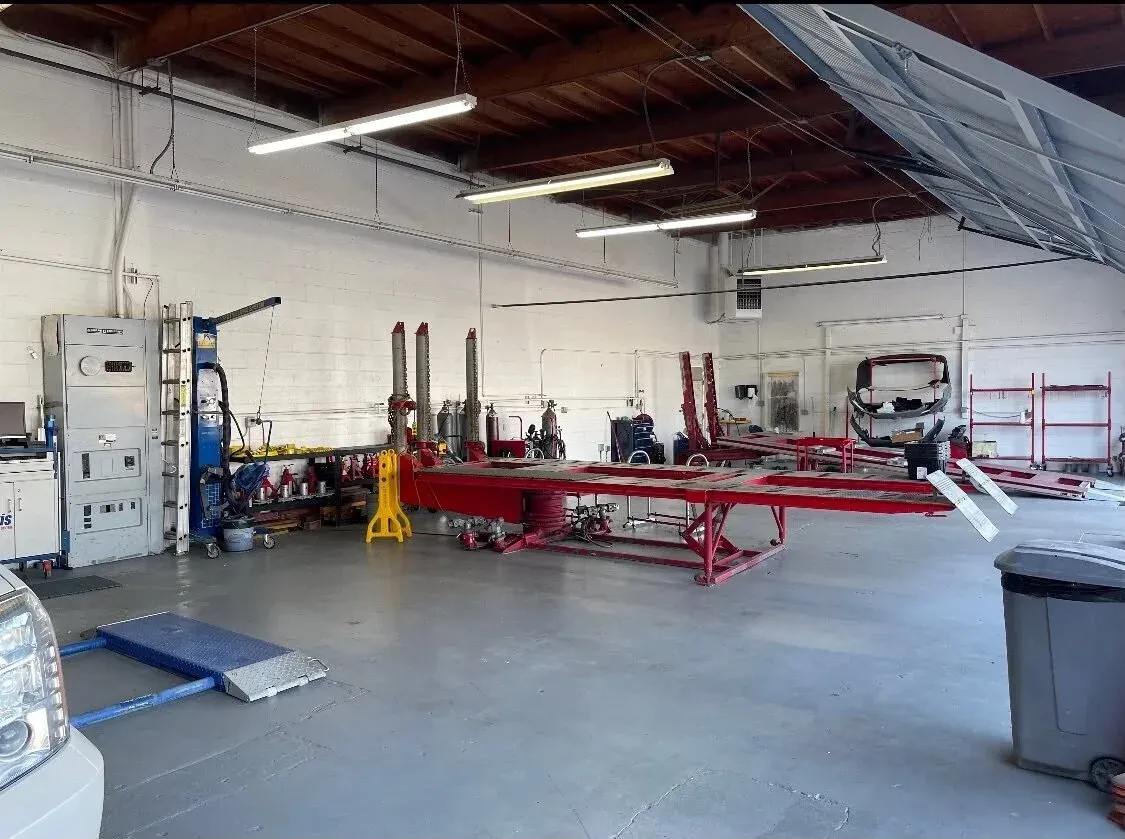
Nearly everything on the road today is a unibody: the body shell is the frame, engineered with crumple zones meant to fold once, in one direction, in a crash. Straightening one is a measurement exercise before it is a strength exercise. The car is anchored on the frame machine, laser-measured at the factory control points, and compared against the manufacturer’s dimensional data. The pulls come in stages — load, correct, release, re-measure — because metal dragged past its target in one heave is metal damaged twice.
Where a rail or apron is kinked beyond what steel tolerates, the correct repair is sectioning or replacement to the manufacturer’s procedure, not a heroic pull, and we tell you which your car needs before the work starts. Every reading, before and after, goes into the file — it backs the supplement with your insurance company, and it is your proof, in writing, that the structure went back to specification rather than to “looks straight.”
- Laser measurement at factory control points before any pull
- Staged, controlled pulls with re-measurement between each
- Sectioning or rail replacement when the metal is past straightening
- Full dimensional documentation kept in your claim file
Repair, or total loss? An honest answer either way
Structural jobs are where the total-loss question shows up. Ontario sets no fixed percentage — your insurance company weighs the car’s actual cash value against repair cost plus salvage value and decides from there. Our part is documentation without thumb-on-scale: the teardown photos and measurements show exactly what the repair involves, and if the honest arithmetic says the car should not be fixed, you will hear that from us first. When it is worth fixing, the same file becomes the evidence that gets the full repair approved.
A car with suspect structure should travel by tow truck, and Ontario’s towing rules put the destination in your control — say Collision Auto Center and it arrives here, not at a yard charging storage while the claim idles. After straightening, the car is aligned and road-tested before handover, because the last check that matters is how it tracks down an actual road. Reach us at (647) 594-3401, Monday to Saturday 8 AM to 7 PM, Sundays by appointment — the owner walks you through the findings.