How does sun and UV damage car paint?
Quick answer
Ultraviolet light carries enough energy to snap the chemical bonds in your clear coat and the pigments below it. The clear’s built-in UV absorbers soak up the punishment first, and once they are spent the resin itself starts to break down — gloss flattens, a chalky haze forms, and eventually the film cracks and peels. Panels that face the sky always fail first.
- Drivable or not
- At fault or not
- Free written estimates
What UV actually does to a finish
A paint film is a polymer — long molecular chains holding hands. Each ultraviolet photon that lands carries enough energy to break some of those bonds, and every sunny hour breaks a few more. The process is invisible, cumulative, and entirely one-directional.
Manufacturers defend against it by loading the clear coat with UV absorbers and stabilizers: sacrificial molecules that intercept the energy and dump it as harmless heat. They work brilliantly, and they are consumed doing it — think fuel tank, not force field.
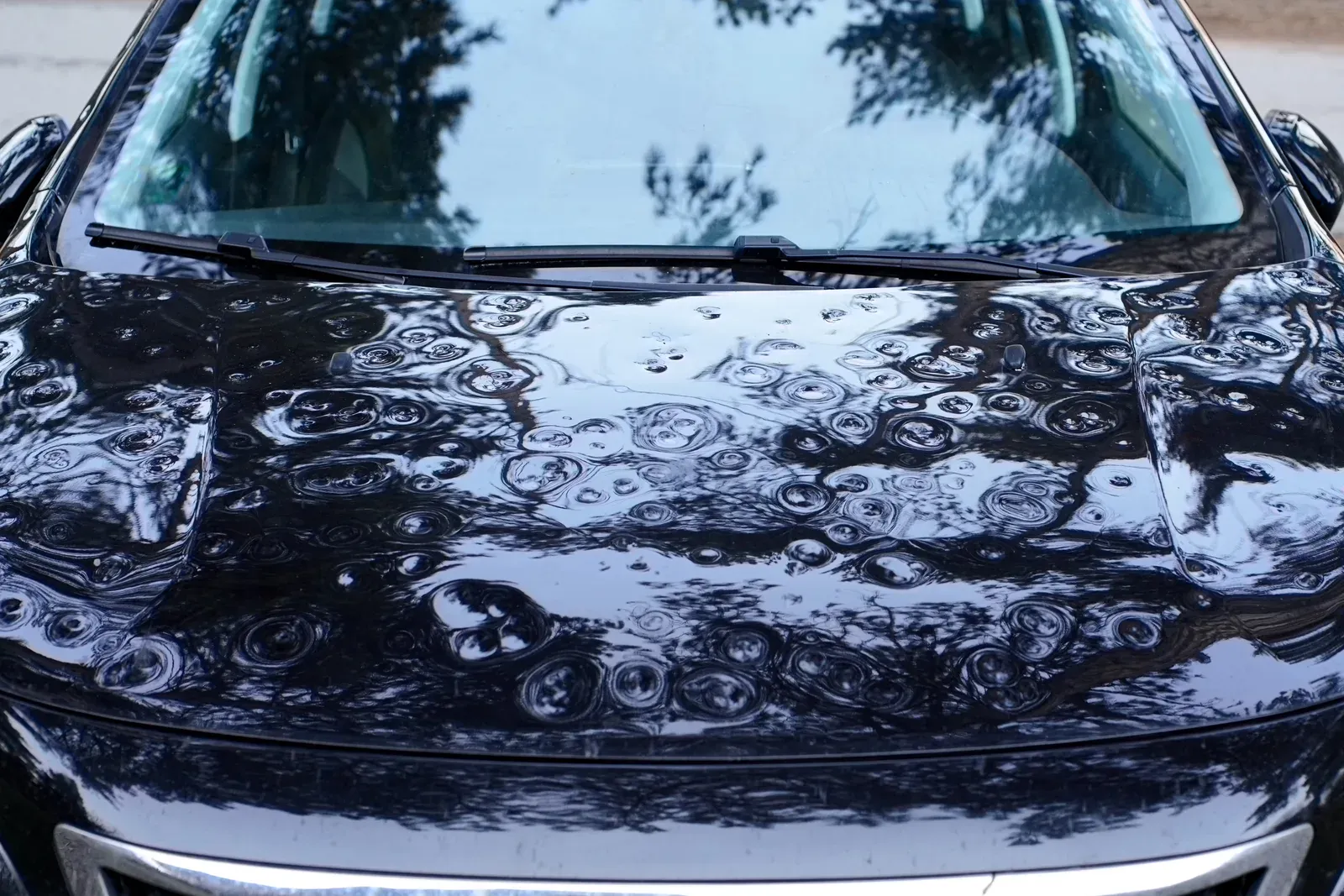
When the tank runs dry, the resin takes the photons directly. Gloss dies first, then a milky chalkiness spreads, then a lattice of micro-cracks opens. Water enters the cracks, the bond between clear and base coat lets go, and the film starts lifting in sheets.
Pigments age in parallel. Reds and other organic pigments are the most fragile — the reason an old red car drifts toward pink and dark colours go flat and grey. That drift is also why matching an older panel means measuring the paint that exists, not mixing the code that shipped.
Why Ontario is harder on paint than its latitude suggests
Sun damage sounds like a desert problem, but southern Ontario assembles its own punishing combination — it just does it politely.
Summer days here run long: in late June the sun is above the GTA for over fifteen hours, and cumulative dose is what ages paint, not peak intensity. Winter adds a twist most climates skip — snow cover and pale concrete bounce UV back upward, dosing panels from angles they were never going to see in a warmer city.
Then comes thermal cycling. A dark hood parked outdoors in North York can sit near -25 °C on a January night and climb past 60 °C under direct July sun, and the film stretches and shrinks across that entire span. Every cycle flexes a coating UV has already weakened, hurrying the micro-cracking that starts delamination.
Stack road salt, sand blast, and freeze–thaw on top and you have a climate attacking paint from several directions at once. A GTA car that sleeps outside for ten years has passed a genuinely brutal endurance test — and the grade is usually written on its roof.
The failure order is completely predictable
UV damage follows the sun’s geometry, so the sequence never varies much:
- Roof, hood, and trunk lid — square to the sky, hottest surfaces, first to go
- The top third of vertical panels, worst on whichever side faces the street where the car parks
- Plastic trim and mirror caps, which chalk toward grey
- Headlamp lenses, which yellow and haze as their factory coating gives out
- Wiper cowls, roof rails, and other exposed black plastics
- Vinyl wraps and graphics, which fade and shrink ahead of the paint beneath them
- Dashboards and interior plastics, cooked through the windshield
- Weatherstrip and rubber seals, which dry, harden, and split
What genuinely slows it down
Shade wins, and nothing bottled comes close. A garaged car and a driveway car age like different vehicles, and even a carport or the shadowed side of a building buys measurable years. In condo buildings, the underground spot is doing more for your paint than any product you could apply.
Second place goes to a sacrificial layer: wax survives a couple of months, synthetic sealants longer, ceramic coatings longer still. Each takes UV and contamination on behalf of the clear coat, and each makes every wash easier on the finish.
Wash on a schedule, because bird droppings, sap, and industrial fallout are acidic — they etch resting places into the clear, and etched spots become tomorrow’s failure points. Same-day removal is the rule worth keeping.
And go easy on the polisher. Every aggressive buff removes clear coat, and clear coat does not regenerate. Repeatedly polishing an aging finish back to shine is spending the very layer that protects the colour.
The short version:
- Choose the garage or the shade every time there is a choice
- Wash every couple of weeks so contaminants never settle in
- Lift droppings and sap the day they land
- Keep wax, sealant, or ceramic on the paint year-round
- Polish rarely, and only with a reason
- Act on roof or hood hazing early, while it is one panel
When prevention is over
There is a hard line. Once clear coat has cracked or begun lifting, no polish or bottled restorer can reassemble it — the film has failed as a structure, and there is nothing left to shine.
Past that line, the fix is a refinish: sand off the failed clear, take the panel to a sound layer or primer, seal it, and spray fresh base and clear out to a natural break line where the edge can hide.
The encouraging part is that early action shrinks the job. Caught at the hazy stage, it is one panel; ignored, it walks across the roof and down the pillars until half the car is quoted. If the roof has lost its reflection while the doors still shine, that is your moment.
Ontario adds a seasonal reason not to sit on it: a panel that goes into winter with exposed base coat or primer meets salt and freeze–thaw with no armour at all, and a paint job quietly becomes a paint-plus-corrosion job by spring.
Where this most often meets our work is on an accident or hail claim: aged, UV-worn paint is exactly why colour gets measured off the car rather than mixed from the factory code, and why blending into the neighbouring panels is written into every claim estimate we prepare — with the refinish backed by a lifetime warranty.