Structure bends at city speeds more often than people think
The hits that move structure downtown are rarely spectacular. A car accelerating up the Spadina ramp meets the back of a stopped lane at 50 km/h and the front rails do exactly what they were engineered to do — fold. A left turn across College taken a half-second late puts the whole impact into one front corner. Black ice on Lake Shore sends a car sideways into a curb hard enough to shove a wheel back into the arch. Even a heavy pillar strike on a tight garage ramp, taken at the wrong angle, can push an apron out of position.
Because nearly every modern vehicle is a unibody, the body shell is the frame — and a shell sitting millimetres off specification can look repairable, even drive tolerably. The evidence shows up sideways: a steering wheel that will not centre after an alignment, hood gaps that taper, a door that needs a shove to latch, one tire shoulder wearing fast. Those millimetres matter because crash structure is designed to collapse in a set sequence, and airbag timing assumes factory geometry. A shell left out of true protects you differently the next time.
Numbers before force, and paper after
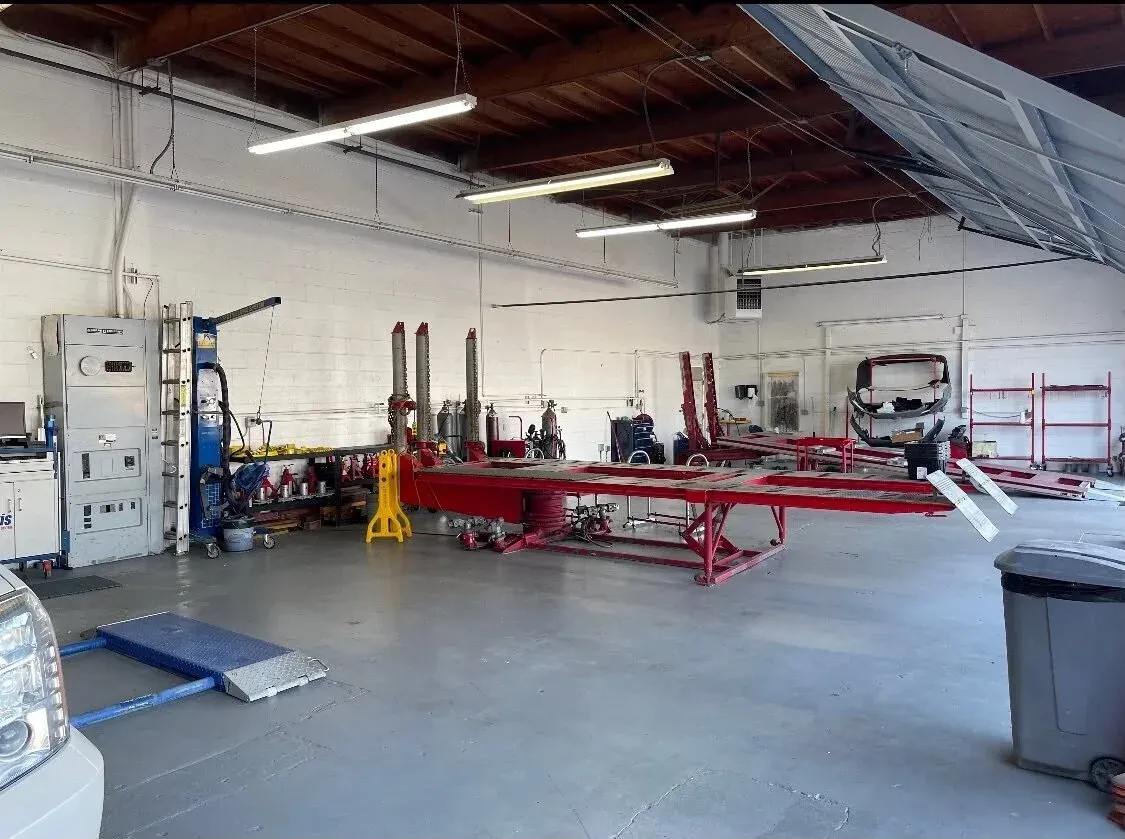
Structural repair here begins on the bench, not with a pull. Reference points across the shell are measured against the factory’s published dimensions, and the printout says precisely which points sit where — no eyeballing. Corrections are applied in increments: force on, force off, re-measure. Metal dragged past its target in one heave has been worked twice, and worked metal is weakened metal. When every point reads within specification, you receive the before-and-after documentation, which matters to your insurance company now and to the car’s resale story later.
Structure is also where the parts conversation gets serious. When a rail section or a reinforcement is being replaced, we push your insurance company for OEM — crash-management parts are exactly the place where like-kind-and-quality substitutes are a false economy, and Ontario lets you insist on originals and cover any difference if it comes to that. Suspension disturbed by the same impact is measured and aligned after the structural work, and the car is road-tested before you get the call to come north.
Tow-ins from the core, and the write-off conversation
A structurally damaged car should not attempt the DVP. If the wheels sit wrong, a door binds, anything leaks, or the steering pulls, leave it exactly where it stopped — curb lane, garage, or ramp — and call (647) 594-3401. We coordinate the tow, including out of height-restricted downtown garages, and Ontario’s towing rules mean the destination is yours to choose: this shop, not whichever yard the truck favours. Photos from the scene start the estimate before the car arrives.
The other conversation happens early and honestly. Ontario sets no fixed percentage for a write-off; the insurance company weighs the car’s actual cash value against repair cost plus salvage, case by case, and structural jobs are costly enough to put some cars near that line. You deserve that answer in week one, not week four. When the math favours repair, we fix it to specification, document it, and warranty the work. When it does not, the owner says so plainly and helps you deal with what follows.