When a hit goes past the bumper
The collisions that reach structure in Parkdale mostly come from two places: the Gardiner and Lake Shore, where speed differences at the Jameson merge turn a moment’s hesitation into a heavy rear-end or front-corner hit, and the streetcar intersections on Queen and King, where a left turn across traffic ends in a strike square on a wheel or frame rail. Nearly every modern car here is a unibody — the “frame” is the body itself, a network of rails, aprons, and pillars engineered to crumple in specific zones and stay rigid everywhere else.
Structural damage announces itself in some cars and hides in others. Doors that no longer shut with the same sound, panel gaps that widen from top to bottom, a steering wheel held slightly off-centre to track straight, new tire wear on one shoulder — all are worth taking seriously after a hard hit. But a rail can sit several millimetres out of position without producing any symptom you would notice on a drive up Roncesvalles. Measurement is the only honest answer, which is why suspected structural damage here goes on the bench rather than past a tape measure.
Measured, corrected, measured again
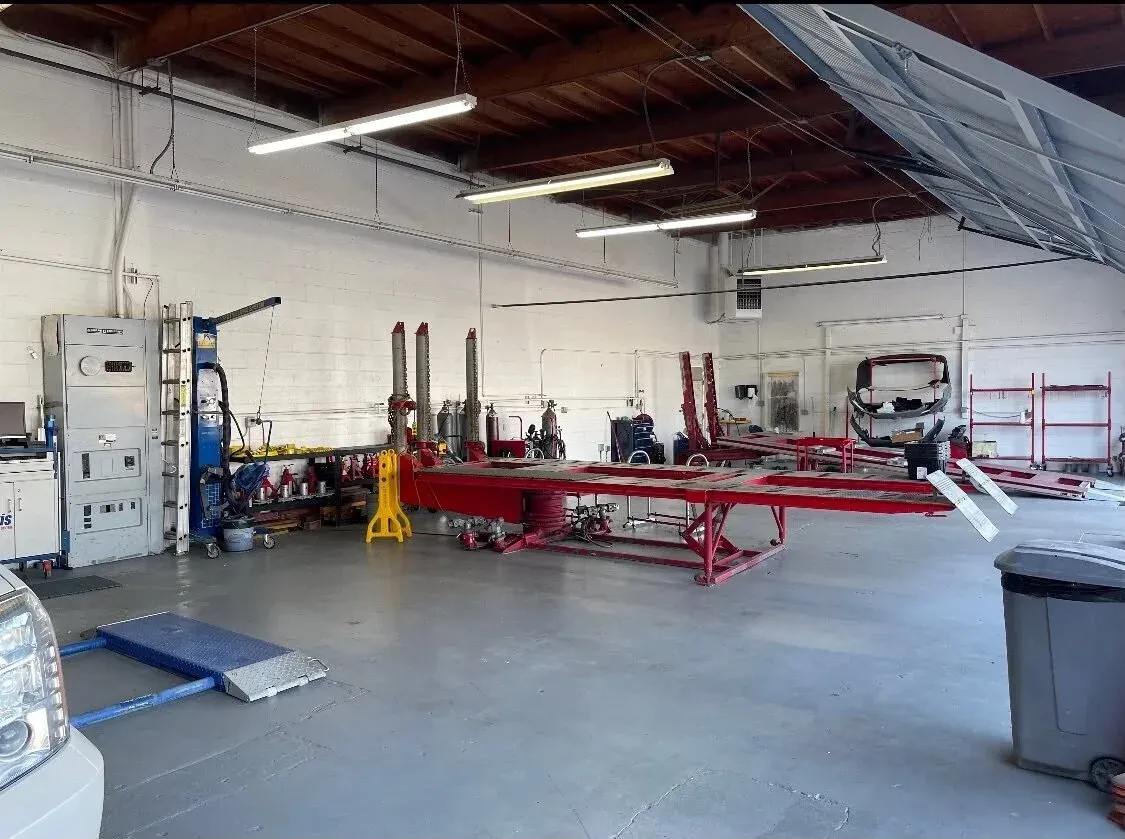
The process is deliberately unexciting. The vehicle is anchored, its control points are measured against the dimensional data the manufacturer publishes for that exact body, and the readout shows precisely which points have moved and by how much. Correction happens as a series of controlled pulls — force applied gradually and in sequence, never one dramatic yank — with measurements repeated as the structure returns to specification. The before-and-after data is recorded and goes into the claim file as proof the geometry is right, not an assurance that it is.
Not every damaged section should be pulled. Metal that has kinked sharply, torn, or crumpled in an engineered crush zone is replaced rather than straightened, because those zones protect you by deforming and must be able to do it again. On older Parkdale cars we also weigh corrosion: a rail that has spent fifteen winters over salted pavement may need more replacement than pulling. Those judgement calls are explained to you before the work happens, in plain language, with the measurements on the table.
- Anchored measuring against manufacturer dimensional data
- Controlled, sequential pulls — never a single hard yank
- Kinked or crush-zone metal replaced, not straightened
- Before-and-after measurements documented in your claim file
Total loss, tow-ins, and what we tell you straight
Structural damage raises the total-loss question, so here is how Ontario actually handles it: there is no fixed percentage that writes a car off. The insurance company weighs the vehicle’s actual cash value against the repair cost plus salvage value and decides case by case. Our job is to make sure that decision rests on accurate numbers — a complete teardown, a documented measurement report, and a realistic repair plan. If the math genuinely says the car is done, we will tell you that before anyone burns weeks pretending otherwise.
A car with structural damage usually is not driving up Keele, and it should not. Call (647) 594-3401 from wherever it stopped — a Lake Shore shoulder, a tower garage on Jameson, a curb lane off Queen — and we coordinate the tow. Ontario’s towing rules put the destination in your hands, so name this shop and the car comes straight here instead of accumulating storage fees somewhere else. From there the claim, the adjuster, and the supplements are our work, and you get updates from the person actually repairing the car.