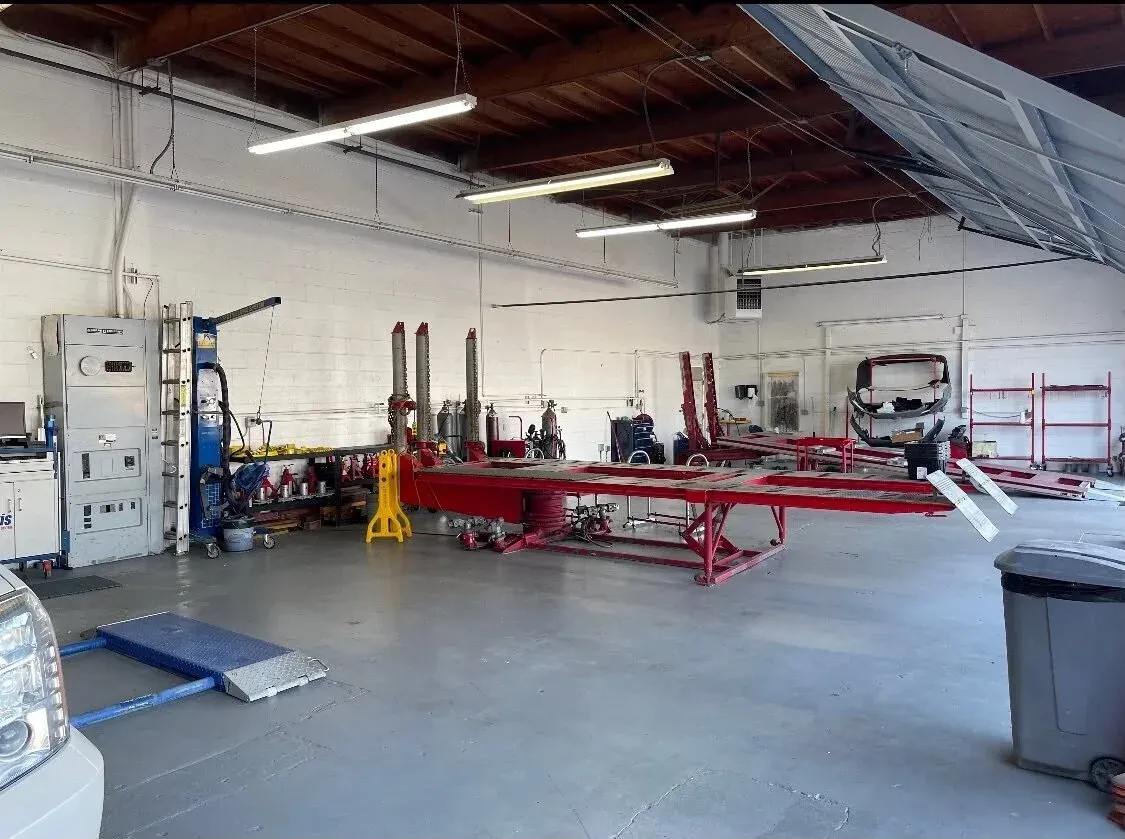
Grades and speed: how Hamilton bends structure
The Mountain gives Hamilton something no other city on our map has: real grades in real winter. When freezing rain hits the accesses, cars lose grip on the Jolley Cut or the Claremont and ride the curb or the guardrail down — and a curb strike at even modest speed drives force through the wheel into the control arm, the strut tower, and the rail. Meanwhile the Linc and the Red Hill Valley Parkway carry cross-town traffic at 90-plus km/h, and a sudden slowdown at those speeds produces the accordion hits where energy travels the length of the car.
Structural damage doesn’t always announce itself. After a hit that looked cosmetic, the tell-tales show up in daily driving: a door that needs a lift to latch, a steering wheel that sits off-centre on a straight stretch of Main, front tires wearing unevenly within a month. A unibody car — which is nearly everything on the road now — uses the body shell itself as the frame, so a few millimetres of movement in a rail or an apron changes how the whole car sits, steers, and crashes the next time.
Measured before, pulled in stages, measured after
Nobody can see three millimetres. Every suspected structural job here goes onto the measuring system before repair decisions are made, and the readings are compared against the manufacturer’s reference points — that’s the difference between correcting a structure and eyeballing one. Pulls happen in controlled stages, metal is persuaded rather than yanked, and the after-measurements go into the file next to the before-measurements so the correction is proven, not asserted.
Where metal has kinked or torn past the point of safe straightening, the section gets replaced instead — and for structural components we push your insurance company hard for OEM parts, because crash behaviour is exactly the situation where like-kind-and-quality is not good enough. Corrosion protection is restored to every repaired seam, which matters doubly on a car returning to salted Hamilton winters, and the vehicle is road-tested before the keys come back.
- Full measurement against factory reference points before any pull
- Staged corrections with documented before-and-after readings
- OEM structural parts argued for with your insurance company
- Corrosion protection restored on every repaired section
Repair or write-off — and how the car gets here
Big structural jobs raise the total-loss question, and Ontario has no fixed statutory percentage that decides it: the insurance company weighs the vehicle’s actual cash value against repair cost plus salvage value. What we control is the quality of the information that decision rests on. A documented teardown and a measured damage map mean the repair-versus-write-off call gets made on facts — and when a repair genuinely isn’t in your interest, the owner will tell you that plainly rather than chase the job.
Most Hamilton structural work arrives on a flatbed, and the logistics matter more than people expect. If your car is sitting at a Hamilton tow yard, storage charges are accruing daily while the claim inches forward — and under Ontario’s towing rules the destination is your decision, so the car can come to us the moment you make the call. Phone (647) 594-3401 and we coordinate the tow, open the claim, and start the estimate from photos while the truck is booked.