The hits around here that reach the structure
Almost no modern car has a frame in the old sense — the body itself is the structure, engineered to crumple in specific zones so the cabin does not. That is why hits that look survivable on the outside can still be structural underneath. The 427’s short merges at Dundas and Burnhamthorpe produce the rear-enders that shove a rear body panel and buckle a trunk floor. The rebuilt Six Points intersections produce front-corner hits from misjudged left turns, driving energy into a rail tip and the suspension mounting behind it.
The neighbourhood’s quieter structural risk is the February pothole. The craters that open along Dundas and Royal York after a freeze–thaw week can bend more than a wheel — a hard enough strike moves suspension pickup points, and a car like that will pass a casual glance while quietly eating its front tires. The test is not whether it drives. It is whether every mounting point sits where the factory put it, and only measurement answers that.
Measured before, pulled in steps, measured after
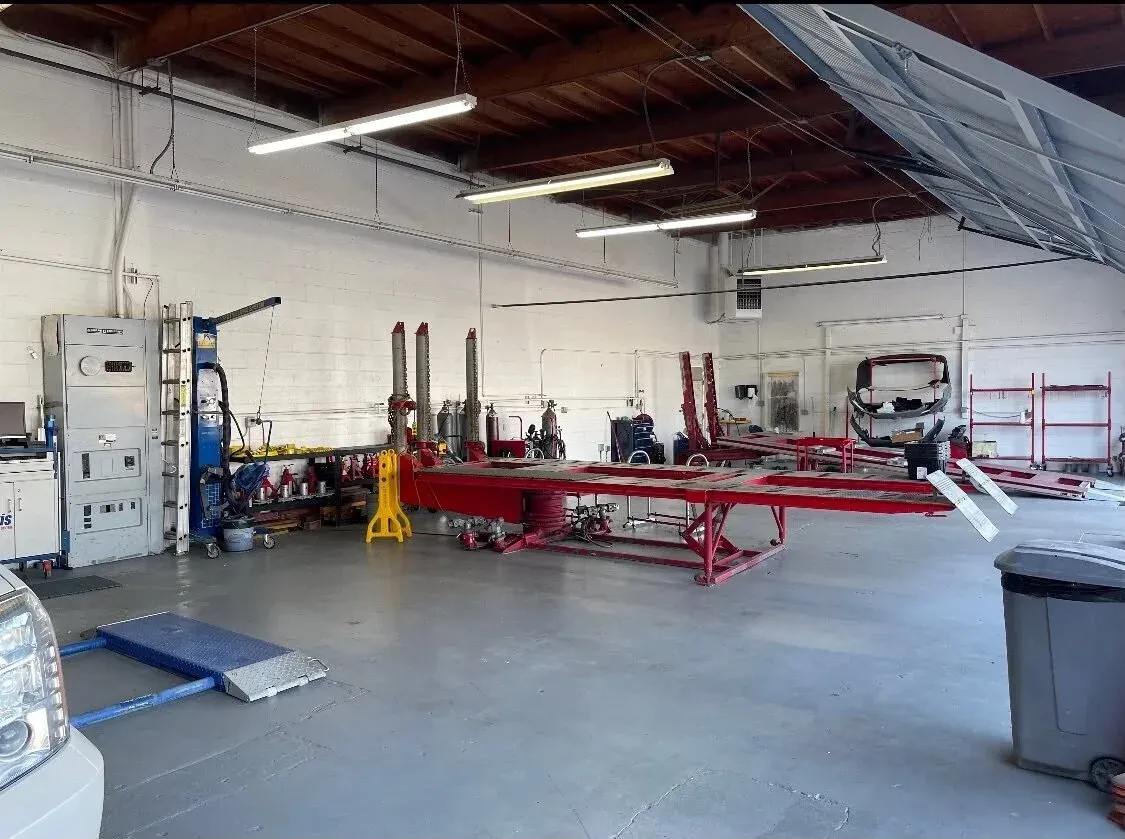
Structural repair here is a documentation exercise as much as a mechanical one. The vehicle goes onto the bench, reference points across the body are measured against the manufacturer’s specifications, and the printout shows exactly what moved and by how many millimetres. The pull happens in controlled increments — metal that gets dragged back in one heave is metal that has been work-hardened twice — and the finishing measurement proves the geometry is back within tolerance. You get both sets of numbers, not our word for it.
Where the manufacturer says a component must be replaced rather than straightened — common with high-strength steels in crash zones — we replace it and say why on the estimate. Sections that were designed to absorb energy once do not get a second career. After structure comes everything downstream: suspension alignment, panel fit, refinish, and the sensor and camera positions that assume the body is dimensionally correct. A car that needed the bench gets a road test before anyone calls you.
- Baseline measurement against factory dimensions, printed and kept in the file
- Controlled pulls, never a single dramatic yank
- Manufacturer-mandated replacements honoured over straightening
- Post-repair measurement, alignment, and road test before pickup
When straightening is the wrong answer
Some cars should not be repaired, and you deserve to hear that from the shop, not just the adjuster. In Ontario there is no fixed percentage that makes a car a total loss — the insurance company weighs the vehicle’s actual cash value against repair cost plus salvage and decides case by case. Our job in that conversation is accuracy: a teardown-based estimate that neither inflates the damage nor buries costs that would surface mid-repair, so the decision gets made once, on real information.
Logistics matter more with structural damage because the car usually cannot self-deliver. Do not let anyone drive a vehicle with a wheel sitting visibly wrong, even the 14 km up Islington Avenue. Call (647) 594-3401, and we coordinate the flatbed from your garage ramp, the 427 shoulder, or the impound lot — under Ontario’s towing rules, where the truck takes your car is your decision, stated on an itemized invoice. The claim, the supplements, and the adjuster all get handled from our office while you get updates directly from the shop.