What a 427-speed hit does underneath
Etobicoke’s highway ring means its worst collisions happen at real speed — the 427’s ramps at the 401 stack, the QEW split near Sherway, the Gardiner merge east of Islington. A modern car manages that energy by design: the unibody’s rails and crumple zones fold deliberately so the cabin does not. The cost of that protection is that structure which has done its job is no longer where the factory put it — sometimes by centimetres, more often by a few millimetres nobody can see from the curb.
The signs surface in small ways first. Panel gaps that taper. A hood that needs a shove to latch. A door that drops slightly on its hinges. A steering wheel sitting off-centre on a straight run down Browns Line, or new tires wearing unevenly within a month. Any of those after a hit — including a hit that was already repaired somewhere quick — is a reason to measure, because a unibody out of specification carries its weakness into the next collision.
Measured, pulled, measured again
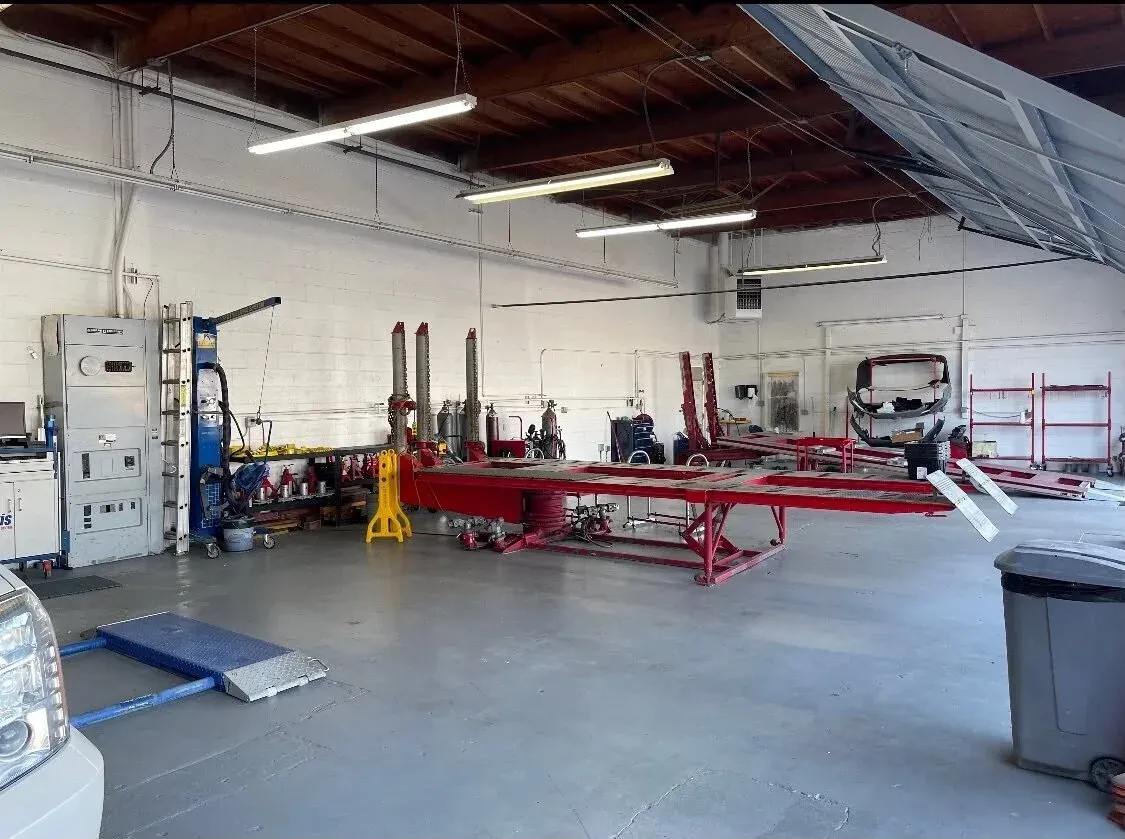
Frame work here is arithmetic before it is force. The vehicle goes on the bench, reference points across the underbody are measured against the manufacturer’s specification, and a record of what moved and by how much exists before anything is pulled. The correction itself happens in controlled stages — anchored, pulled, re-measured — rather than one dramatic yank, because steel persuaded gradually holds its shape and steel forced in one go does not.
Where the structure is kinked or its strength is compromised, straightening is the wrong answer, and the affected section or rail is replaced instead — with OEM parts requested, because this is exactly the safety-relevant territory where we push your insurance company to write for them. Suspension mounting points are verified so the wheel alignment actually holds, and the finished measurements are filed next to the starting ones. You leave with evidence the car is straight, not just an assurance.
- Underbody reference points measured against factory specification
- Pulls made in anchored, documented stages — never one big yank
- Kinked or weakened rails sectioned and replaced, not forced back
- Final measurements and a road test recorded before handover
Tow-ins, claims, and the total-loss question
A car with structural damage should not be limping up the 427, so most of this work arrives on a flatbed. Ontario’s towing rules are on your side: the driver chooses where the vehicle goes, and the operator owes you an itemized invoice. From a collision scene on the QEW or after a Collision Reporting Centre visit, name Collision Auto Center in North York and call (647) 594-3401 — we help coordinate the rest, including the rental through your coverage while the car is on the bench.
Structural estimates are where the total-loss question lives, and we answer it honestly. Ontario sets no fixed percentage; your insurance company weighs the vehicle’s actual cash value against repair cost plus salvage value, and on an older car a bent rail can tip that math. We document the damage the same way in either case, tell you which side of the line we believe the car falls on, and run the claim from there. If it repairs, it leaves measured to specification and road-tested.