What a downdraft booth actually controls
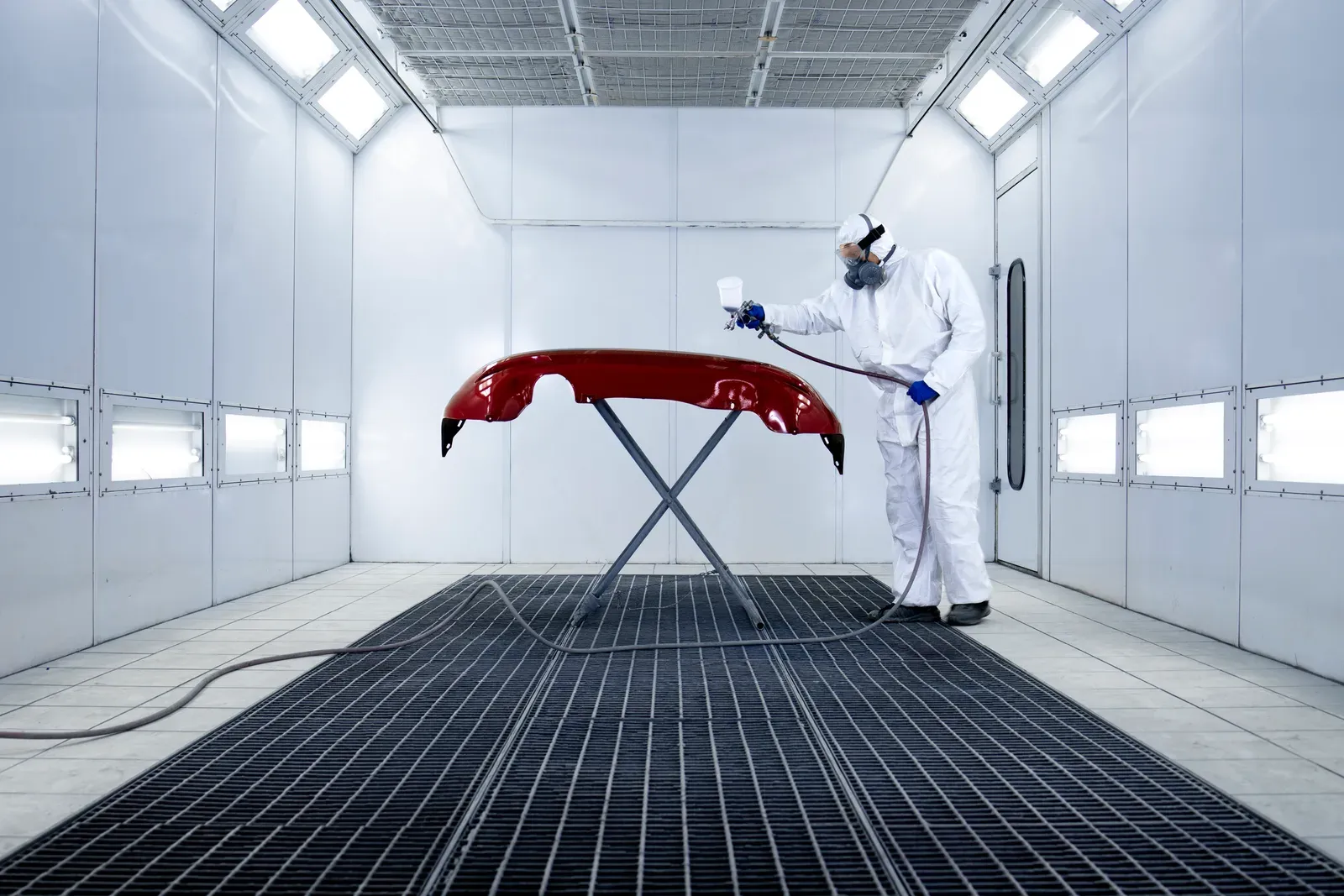
Sprayed paint spends several minutes wet, and whatever is drifting through the air in those minutes becomes part of the finish. The booth answers that with direction. Clean, filtered air is pushed in through the ceiling, moves down past the panel in a single pass, and exits through grates under the car, taking sanding dust and atomized overspray with it. Try the same spray job in an open bay — especially in a Toronto winter, when every car dragging in from Keele Street sheds salt film and grit — and those particles land in the clearcoat before it ever flashes off.
The booth also decides how the finish cures. Toronto swings from minus fifteen in January to humid thirty-degree afternoons in July, and paint applied in either extreme behaves badly if the environment is left to chance. Inside the booth, temperature and air movement are held constant while the basecoat flashes and the clear sets, so the film builds at one even rate across the whole panel. When part of a panel skins over fast and another part lags, the result is the faint texture mismatch you can spot on hurried bodywork — the colour is right and the panel still looks wrong in low sun.
How your car moves through the booth
The booth is the last stop, never the first. Bodywork happens in the prep area: panels straightened, primed, and block-sanded dead flat, because a coat of gloss enlarges a low spot instead of burying it. Then the car is masked — glass, mouldings, door jambs, and every gap that mist could find its way into. Only after that does it roll onto the booth floor for a final tack wipe and the spray itself. Send a wavy panel into the booth and you get the same wave back with clearcoat over it, and at that point the only honest fix is to sand it off and begin again.
When the cure is done, the masking comes off and reassembly starts: lamps, badges, trim, and fasteners returned to the positions the factory gave them. The new finish is then de-nibbed and machine-polished until its gloss agrees with the panels on either side. This last step is quieter than the spraying and matters just as much — a repair can carry a perfect colour and still announce itself by being shinier than eight-year-old paint beside it. Levelling the sheen is what makes the repair disappear at a walking pace, which is the test that counts.
- Straightening, filler, and primer all finished before the booth
- Panels block-sanded flat, then washed and degreased
- Glass, trim, jambs, and openings fully masked
- Basecoat applied and blended, clearcoat carried over the blend
- Controlled cure, then unmasking, reassembly, and polishing
Why booth conditions still matter five winters later
A refinish laid down in filtered air at proper film thickness simply lasts. One that was hurried fails on a schedule you can almost predict. Dust trapped under the clear leaves high points where the film is thinnest, and thin film is exactly where a GTA winter goes to work — road salt, sand, and the freeze–thaw cycle probing the surface until an edge lets go. Most of the peeling that gets blamed on bad paint was really contamination or short film build on the day it was sprayed.
That is the reason we can put a lifetime warranty on every paint and refinish job — good for as long as you own the vehicle, in writing, handed over with your estimate. A shop can only sign a promise like that when it controls the room the work happens in. The prep area and the booth are the two places where that control lives, and nothing about either shows up on an invoice as a separate line. What shows up is a hood that still looks like the rest of the car after five Februaries of salt spray on the 401.