Why the factory paint code is only a starting point
There is a label in your door jamb or under the hood with a paint code on it, and every match begins there. But a code is a description of the day the car was built. Assembly plants mix within a tolerance, which means two vehicles wearing the same code can leave the line noticeably apart — and that gap only widens once the car starts living outdoors. A decade of GTA summers on a driveway, winter after winter of salt film and pressure washes, and the finish on the car is no longer the finish in the book.
Mix straight from the code and spray it on a sun-aged hood and you get a panel that is technically correct and obviously wrong. The honest approach is to measure the car rather than trust the sticker. A reading taken from a cleaned patch of your own paint captures what the surface actually is right now, and the formula gets tinted toward that reality instead of toward a number printed years ago in another country. On a vehicle that has commuted up and down the Allen for ten years, the distance between those two starting points is visible from across a parking lot.
The reading, the formula, and the spray-out card
The measurement is taken on a cleaned, lightly polished area close to the repair, since surface oxidation will skew the numbers. Matching software compares the reading against the manufacturer’s variant formulas for your code — most colours have several — and ranks the nearest ones. The software narrows the field; a painter makes the choice. Which variant is right depends on how your paint has aged and what the neighbouring panels look like, and that judgment happens by eye, standing at the car, not at a screen.
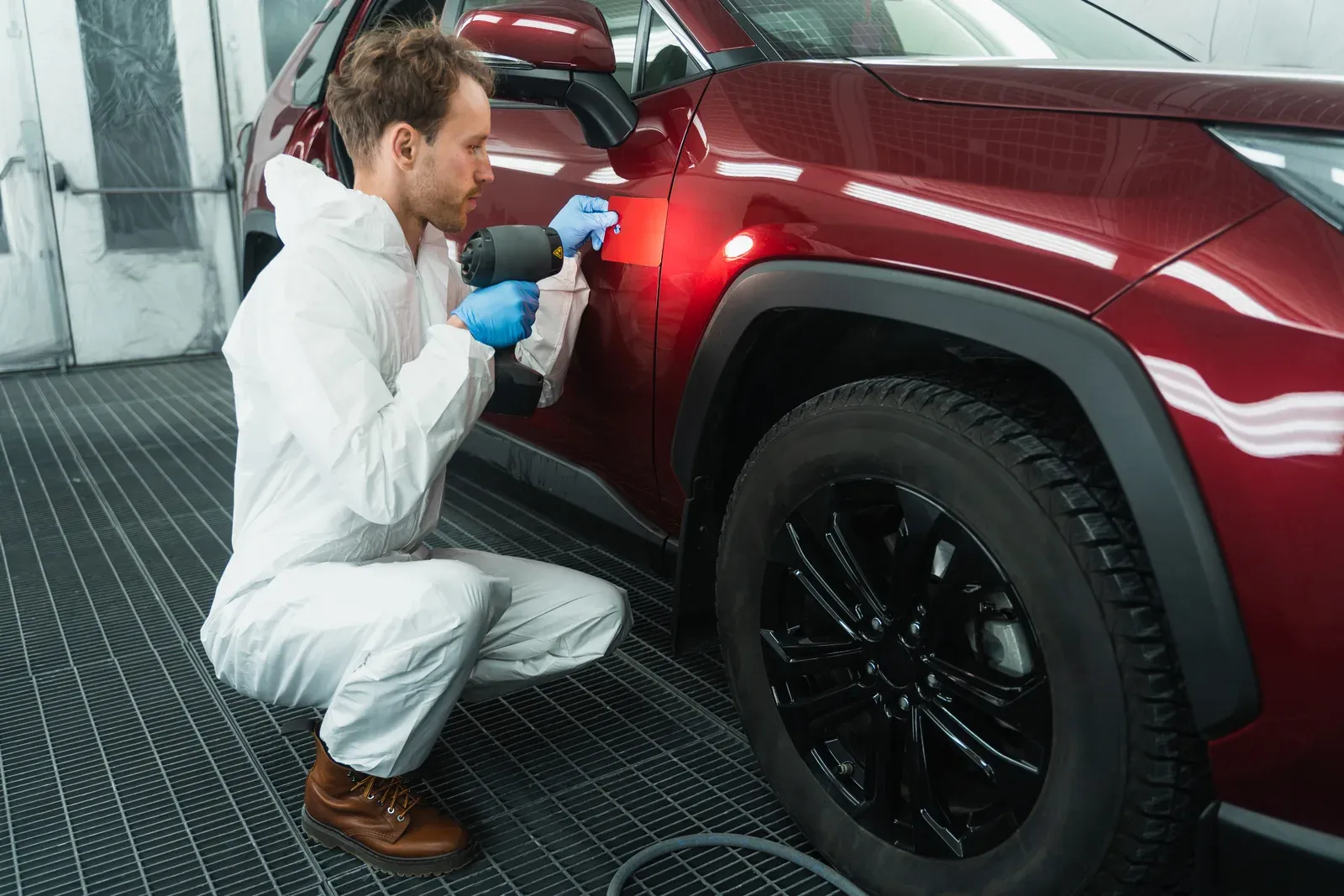
The chosen formula then goes onto a test card, which is cured the same way the vehicle will be cured and held against the panel. Colours that agree under shop lighting can drift apart in daylight, so the card is checked under more than one light source before anyone commits. If it reads off, the mix is tinted and a fresh card goes up. The car is not sprayed until the card sitting against your paint effectively vanishes — that is the pass mark, and there is no partial credit.
- Paint code confirmed from your VIN and the door-jamb label
- Colour measured directly off a cleaned area of your own panel
- Software shortlists factory variants; a painter selects one
- Test card sprayed, cured, and checked under multiple light sources
- Mix tinted and re-carded until it disappears against the car
Blending is what makes the match invisible
Even a dead-on mix will show itself if the new paint stops at a panel gap, because the human eye is built to find a hard line between old and new. Blending erases the line: colour is faded out into the panels on either side of the repair and clearcoat is carried across the entire area, so light sliding down the side of the car never meets an edge. The change from old paint to new happens gradually, over enough distance that the whole flank reads as one unbroken surface.
On metallics, pearls, and tri-coat whites, blending stops being optional. Metallic flake lies in the direction it was sprayed, so a single formula can read a shade lighter or darker depending on gun angle and distance — no mixing bank can fix that. Spreading the transition across a wide area is what hides it. Blending takes more time and more material than stopping at the panel edge, and it is the reason the comment we hear most at pickup is that the owner cannot find where the repair was.