Does an EV need recalibration after a bumper repair?
Quick answer
Usually, yes — the deciding factor is what lives behind the cover. Most EV bumpers house radar modules, ultrasonic parking sensors, and often cameras, each aimed to a fraction of a degree. If a sensor or its bracket was removed or disturbed, the manufacturer’s procedure typically demands a formal calibration — a scan showing no codes is not the same thing.
- Drivable or not
- At fault or not
- Free written estimates
A modern EV bumper is a sensor rack in disguise
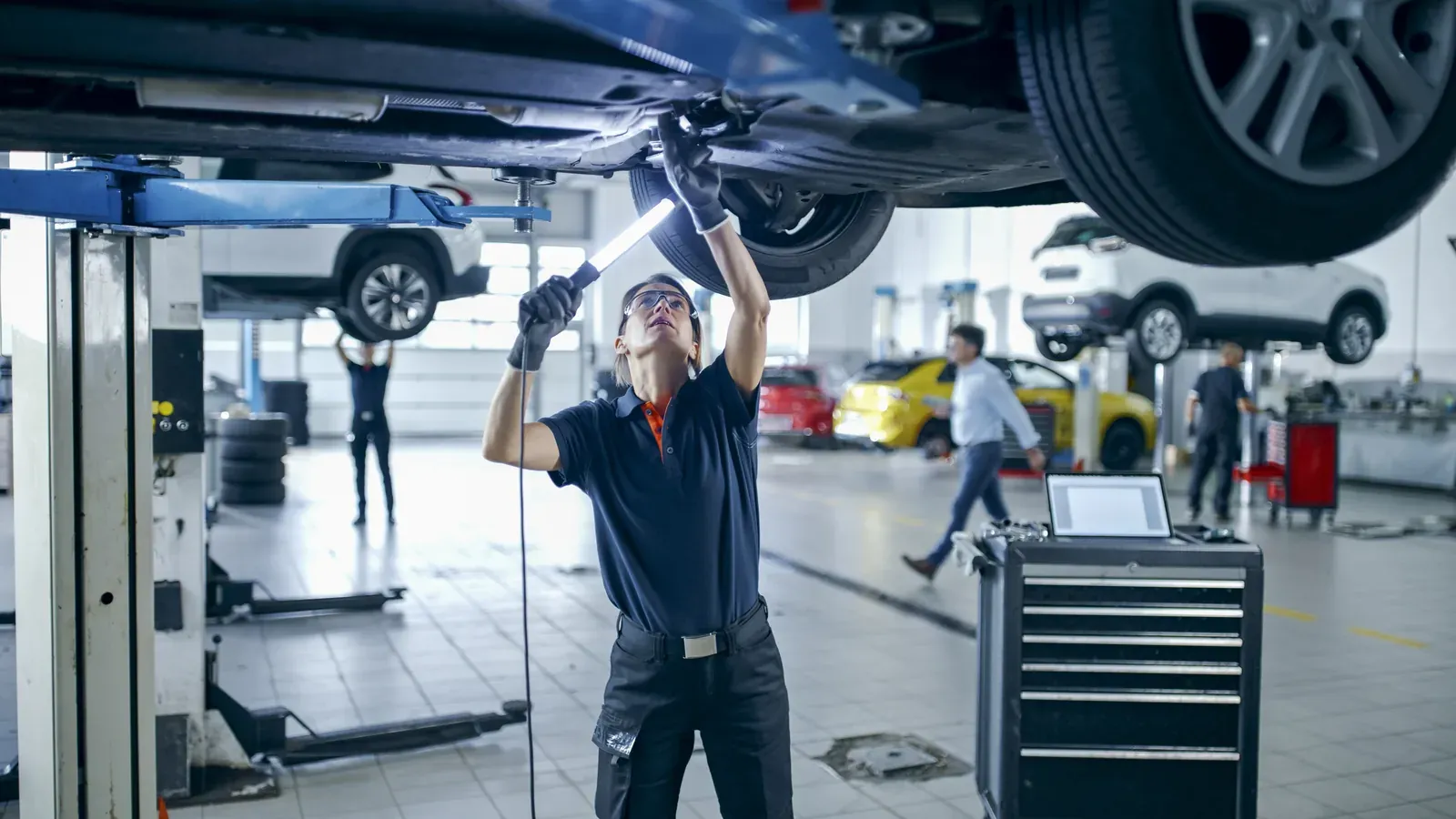
Strip the cover off an EV’s nose and you find an electronics bay: a forward radar for adaptive cruise and emergency braking, a row of ultrasonic sensors, cameras on many models, washer jets for the optics, and the bracketry holding each piece at its engineered angle.
The tail is nearly as busy — corner radars for blind-spot and cross-traffic monitoring, more ultrasonics, and the reversing camera or its harness.
Less obviously, the cover itself belongs to the system. Radar passes through the plastic, so its thickness, its repair history, and even metallic flake in the paint influence the signal — which is why a repaired or repainted cover must be finished to the manufacturer’s specification, not to whatever looks fine.
EVs also simply carry more of this hardware than the average gas car, partly because the fleet skews new and feature-rich. More sensors behind the cover means more bumper jobs that end in a calibration requirement.
Why tiny angles are the whole game
These systems do trigonometry at range, so a minuscule angular error at the bracket grows into a car-width error far down the road — a sensor tilted one degree is pointing at the wrong lane by the time its beam crosses an intersection.
The stakes are concrete: emergency braking deciding which vehicle is actually ahead of you in Allen Road traffic; lane centering deciding where the lane truly ends; blind-spot monitoring deciding whether that gap on the 401 is real.
And the failure is silent. A mis-aimed sensor throws no warning light, because the system has no way to doubt its own geometry — everything behaves normally until the single moment it needed to be right.
Parking sensors are the honest exception: aim one wrong and it chirps at shadows or ignores a pillar, so drivers notice. The long-range systems extend no such courtesy.
- Adaptive cruise — latches onto the wrong car, or drops the right one
- Automatic emergency braking — brakes late, or for the lane beside you
- Lane keeping and centering — steers relative to an edge that is not there
- Blind-spot monitoring — misses real vehicles or invents phantom ones
- Rear cross-traffic alert — watches a narrower or shifted zone than designed
- Parking sonar and surround view — false chirps and warped stitching
What actually triggers a calibration
The published procedure for the specific vehicle is the referee — never a rule of thumb. The recurring triggers:
- A radar or camera unbolted from its bracket — calibration, almost without exception
- A bracket, absorber, or reinforcement replaced or straightened behind the cover — calibration
- A sensor replaced with a new unit — calibration
- A cover removed and refitted with sensors untouched in their mounts — a function check on some models, a full calibration on others
- An impact stiff enough to shift mounting structure, even with the cover unmarked — inspection, and usually calibration
- Suspension work or a ride-height change during the same repair — forward aim is affected
- A wheel alignment, on the many vehicles whose camera references the thrust line
Static, dynamic, and the scan that proves nothing
Static calibration is a shop procedure: level floor, the vehicle set at exact distance and angle from a target board, tire pressures and load within stated tolerances, controlled lighting. Dynamic calibration is a road procedure — a prescribed speed over a prescribed distance on well-marked pavement while the system relearns. Depending on the model, a repair may demand one, the other, or both in a fixed order.
A diagnostic scan answers a different question entirely: are the modules powered, communicating, and free of stored faults. A sensor in perfect electronic health, aimed three degrees into the next lane, sails through that scan spotlessly.
So when a shop offers no codes as the closing argument, the calibration question has not been answered — it has been dodged. The question to ask is whether the manufacturer’s procedure for your vehicle requires calibration after the operations listed on your estimate.
Our practice, and the claims we refuse to make
Sensors come off gently, transfer to new parts only where the manufacturer permits, and return to factory position on original-specification brackets and hardware — because generic clips and aftermarket bracketry are where aim errors are born, and they stay out of our jobs.
Every affected system is function-checked, and wherever the published procedure demands a formal calibration, it is written into the plan and completed before the car leaves. You receive the post-repair scan and the documentation with your keys.
When a particular EV needs a calibration that only the manufacturer’s network can execute, that news arrives at the estimate — we are an independent shop, we claim no brand approvals, and saying plainly where a step belongs is part of doing this properly.
Three questions to ask any shop
They cover everything: Does my vehicle require calibration after this specific repair? Will it be finished before I collect the car, or booked somewhere else? And do I get the pre- and post-repair scan reports in writing?
Clear answers to all three mean the work is being done. A shop that treats calibration as a deletable line whenever an adjuster grumbles is returning cars whose safety systems have never been verified — and nobody driving those cars knows it.
Send photos of your bumper and we will tell you quickly what the repair involves — including, specifically, whether calibration is part of it.
Keep whatever reports you receive with the vehicle afterwards. A documented calibration becomes part of the car’s history — the next shop builds on it after a future windshield or alignment, and a buyer’s inspection reads a verified system very differently from an unknown one. The paperwork costs nothing to keep and keeps answering questions for as long as you own the car.