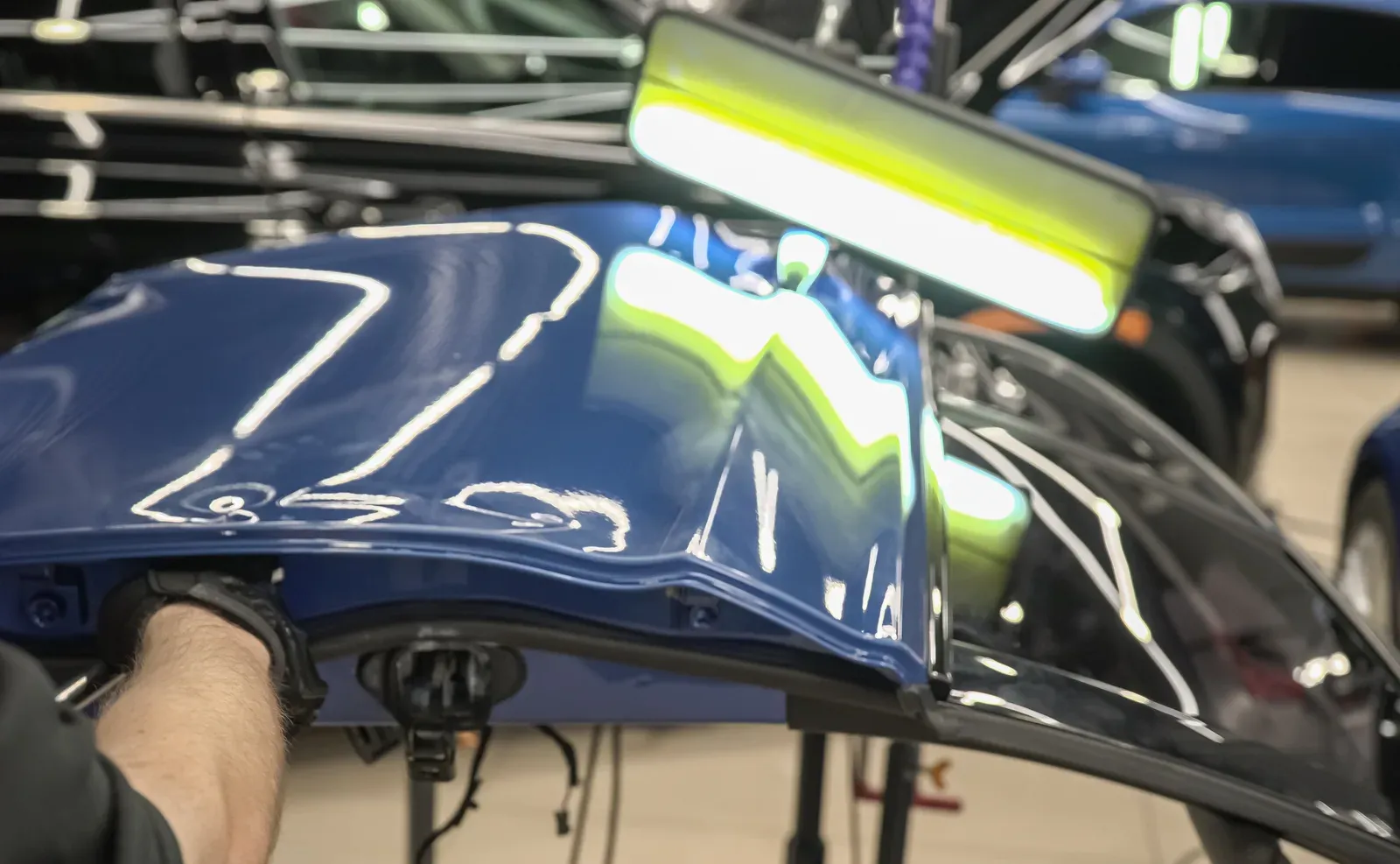
Dents are the neighbourhood’s background noise
Nobody remembers getting most of the dents a Parkdale car carries. A door swung open against yours on a one-way where the parked rows leave centimetres to spare. A delivery van’s mirror in a tight curb lane. A cargo bike handlebar along Queen. A hidden chunk of ice inside a February windrow that turned out to be solid. The tower garages on Jameson contribute their pillar creases, and the curb lanes contribute the mystery dent that simply appeared overnight between Tuesday and Wednesday.
The mistake is treating these as cosmetic and permanent. A dent that broke the paint is an opening, and Toronto road salt is patient — moisture sits in the crease, works at the bare metal, and by spring the ding has grown a ring of rust bubbles that turns a small repair into a bigger one. The cheapest moment to fix a dent is the month it happens. The second-cheapest is now.
Small damage, kept small
Our approach to a dent starts with a decision, not a tool: can this metal be worked back and finished, or has it stretched or creased past the point where a proper repair means a skin or a replacement panel? We make that call honestly, because both directions fail when forced — filler piled into a ruined panel telegraphs within a year, and replacing a panel that could have been metal-finished wastes your money. When repair is right, the work stays local to the damage and the refinish is blended so the fix disappears.
Honesty also applies to the panel around the dent. On an older car whose rocker is already bubbling, we will tell you if the dent is the least of the panel’s problems and price the real repair instead of a cosmetic one. And when a dent genuinely does not matter — shallow, paint intact, on a car you plan to drive into the ground — we will say that too. A quote from this shop is advice, not just a number.
The deductible math, done before you decide
A single door ding usually costs less than, or close to, a typical deductible — which means claiming it through your insurance company rarely makes sense, and we will tell you so from the photos. That is the quiet advantage of a photo quote: you learn what the repair actually costs before anyone opens a claim file, and most single-dent customers simply pay cash and keep their policy out of it entirely.
The calculation flips when the damage is bigger than it looks. A crease running door-to-quarter from a sideswipe, a parked-car strike that pushed the panel into its structure, a collection of dents down one side — that is claim territory, and if another driver was identified, Ontario’s DCPD system generally puts the repair through your own insurance company without it counting as your fault. Either way the process starts the same: photos to us, a written number back, and the decision stays yours. We are at Keele and Sheppard, (647) 594-3401, Monday to Saturday 8 AM to 7 PM.
- Free photo quote — and a straight answer on whether claiming makes sense
- Straight advice when a dent prices under your deductible
- Repairs kept local to the damage; panels replaced only when the metal demands it
- Refinish blended into neighbouring panels and warranted for life