Burlington parks its way into most of its dents
Look at where Burlington cars spend their days and the dent pattern explains itself. The GO lots at Aldershot, Burlington, and Appleby hold thousands of commuter cars door-to-door from dawn to dinner — the classic recipe for door edges swung into quarter panels. Mapleview Centre and the Burlington Centre rows add the backing taps and swung doors that leave a soft crater in a tailgate. Downtown is tighter still: the parallel spots on Brant Street and the side streets off Lakeshore Road ask for judgement in centimetres, and during festival season at Spencer Smith Park, the margins disappear entirely.
The home front contributes the rest. In Millcroft, Alton, and The Orchard, two-car garages hold storage and bikes while the cars sleep on the driveway, so hockey bags, basketball nets, and February windrows all leave their marks. And the older Aldershot streets have their own signature — long narrow driveways beside mature trees, where a dropped branch in a wind storm puts a sharp-edged dent in a roof or hood. Different sources, one common thread: most of it is one panel, and one panel is exactly the kind of job worth pricing from photos before anyone drives anywhere.
Repairing the metal instead of replacing the panel
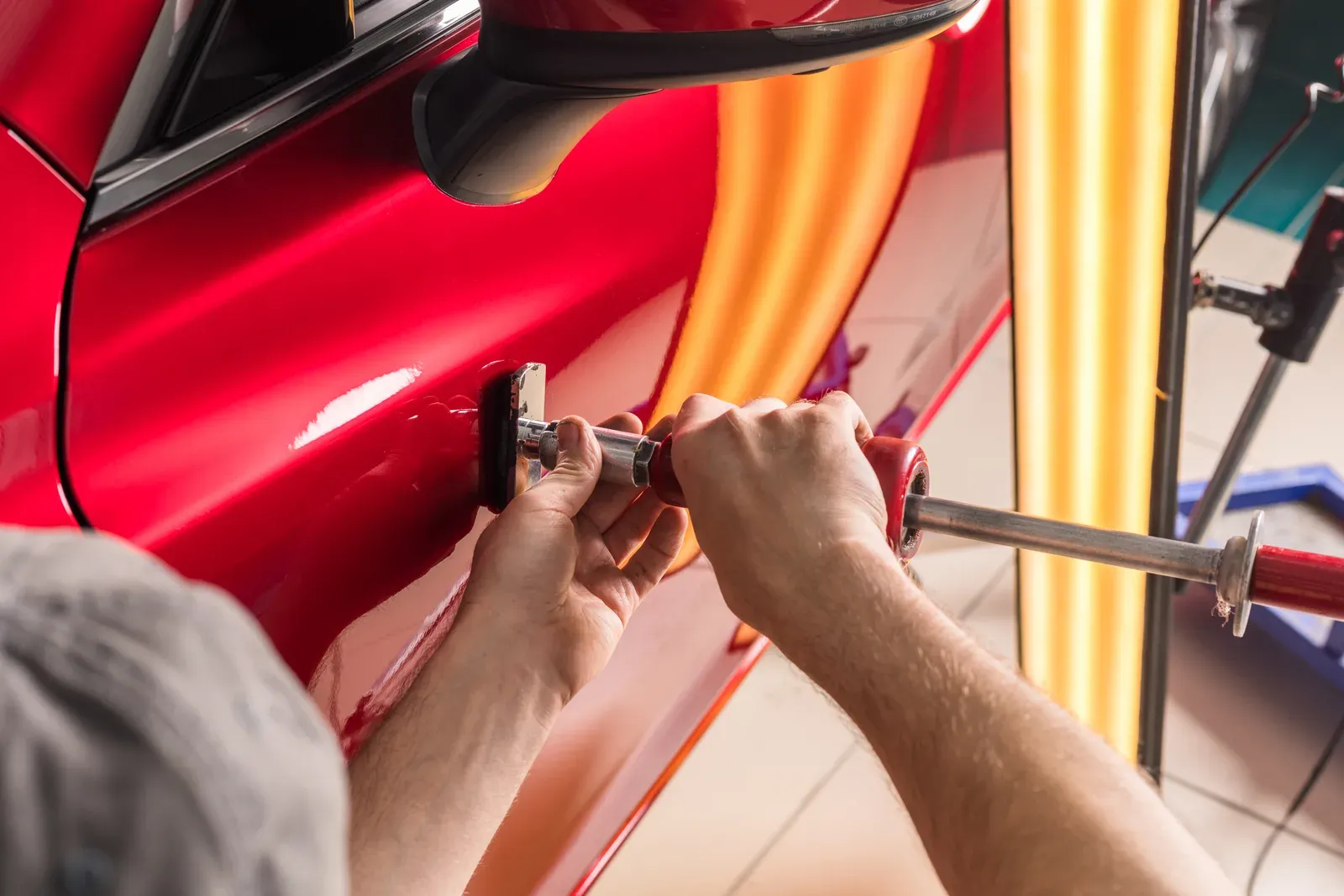
Our default is to save the panel. A shallow ding with intact paint, a crease along a door, a wavy tailgate — these are metal-finishing jobs: the panel is worked back to shape from behind or the surface is straightened, filled only where necessary, and refinished only where the paint actually broke. Where the paint did break, the repair area is primed, based in colour matched to your car as it stands today, and cleared — then blended so the repaired zone has no visible boundary. Replacement is reserved for panels where the metal has stretched past saving or the crease sits over structure.
The honest complication is modern construction. Aluminum hoods and doors behave differently from steel and need different technique; a dent over a body line takes more time than a dent in open metal; and a door with a sensor or side-impact reinforcement behind the skin needs checking, not guessing. This is why the photo quote is written as a range and confirmed in person — but for a straightforward ding, that confirmation takes minutes, not a second appointment, and the repair itself is usually a same-week affair.
- Panel saved and metal-finished wherever the damage allows
- Refinish limited to the actual repair zone, blended outward
- Aluminum panels handled with aluminum-specific technique
- Written photo estimate before you commit to the drive
Claim it or pay for it — the arithmetic, straight
For small dents the first question is not technique, it is money. A single door ding often prices below or near a typical deductible, in which case a claim gains you nothing and we will say exactly that. Where damage is bigger — a grocery-run crease across two panels, a hit-and-run in the Appleby GO lot — the claim can make sense: unidentified-driver and parking-lot scenarios run through your own insurance company, and we open and manage that file for you, including the photographs and the supplement if the teardown finds more.
Either way, the distance from Burlington stays painless. The estimate happens by text to (647) 594-3401. The repair is scheduled so parts and paint are ready the day the car arrives — QEW to the 407 to Keele, about 38 to 52 minutes — and small jobs are sequenced tightly so the car is not sitting idle 55 kilometres from your driveway. Hours run Monday to Saturday, 8 AM to 7 PM, with Sunday drop-offs by appointment, and updates come from the owner directly.